

Donald Sheridan began making works of art in the studio of Andy Warhol, reverentially acknowledged as his teacher. And Warhol, in turn, reverentially acknowledged the talent of his studio crew, which he constantly solicited for advice throughout the art-making process. Upon walking into the Whitney Museum’s “Portraits of the Seventies” show with Sheridan and Rupert Smith, Andy glowed “What a nice show you boys have here!”
Donald Sheridan sincerely considers himself “The Heir” to Warhol’s studio secrets, and with gratitude he dedicates his oeuvre “To Andy”.
For two decades, Sheridan made works of art for his own pleasure, giving them away as gifts and never thinking about exhibiting. Using screens and handpainting, as his mentor, he produced cartoons, abstractions, and political works which were mostly photo-based. Occasionally a friend would include him in an exhibition, or buy something. Slowly, by virtue of the arresting nature and simple visual appeal of his Warholian pieces, Sheridan’s work gained a following.
It seems fitting that the first image to launch Sheridan’s career as an artist is drawn from the front page of the New York Post on February 23, 1987, announcing the death of Andy Warhol. At that time, he produced the first “Post” paintings (shown at the Limelight), plus an edition of t-shirts sent to Japan. Fifteen years later, a collector saw a t-shirt and requested some paintings, resulting in a wall of 27 “Post” paintings of various colors and thick glitter, installed at Wooster Projects in Soho. 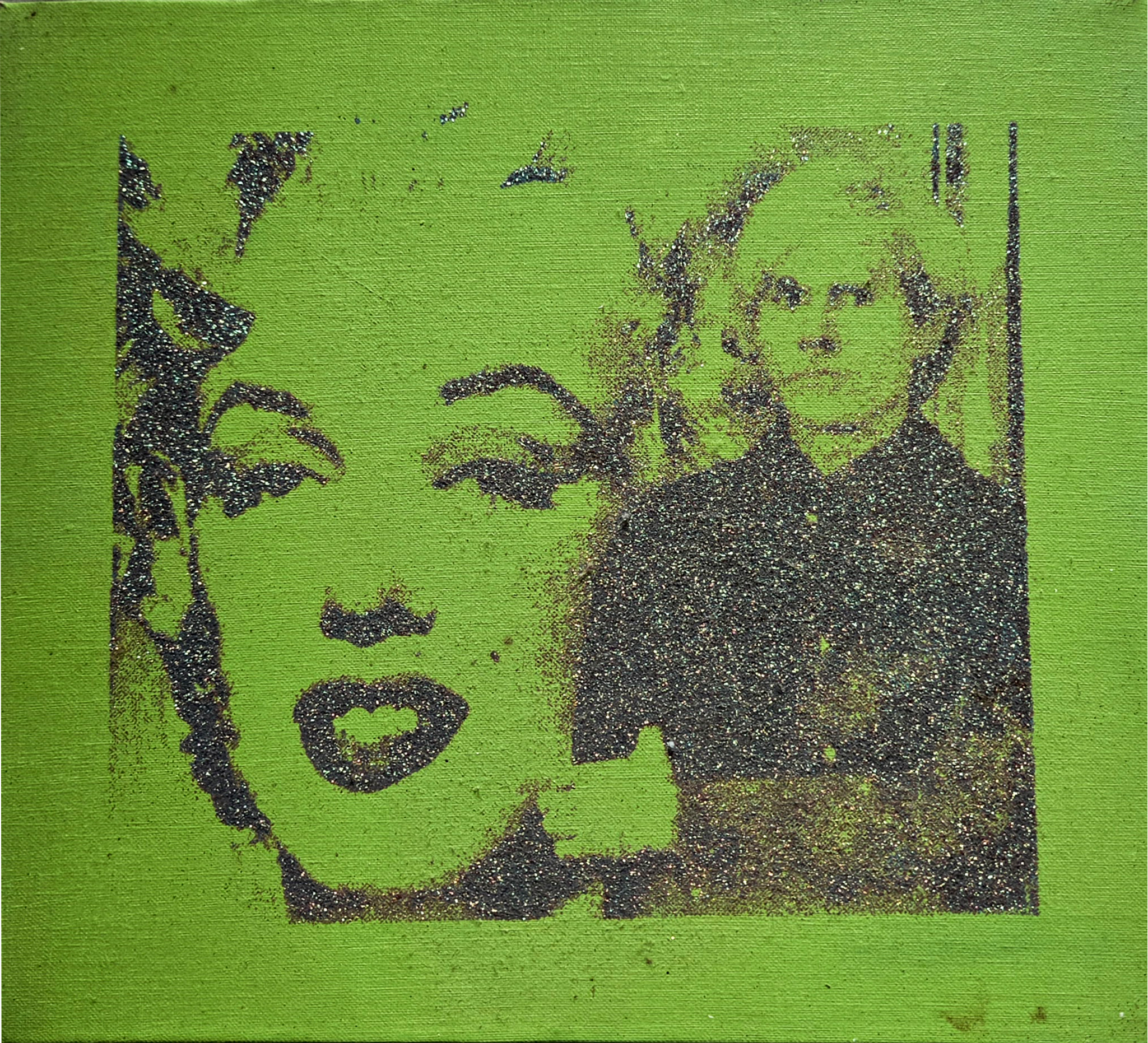 The entire wall sold immediately. “Post” pieces are currently in “The Daily News”, a three museum show travelling through 2006.
Born a Navy brat, Sheridan studied psychiatry in college, worked for the UN, and discovered early on that he preferred a more artistic lifestyle doing construction and odd jobs. The first screenprint he helped produce was the 1968 poster of “Eldridge Cleaver for President”. By 1977, he was working with Rupert Smith, Warhol’s main printer, and he remained with the Warhol team until 1982. This was the University of Andy, as Sheridan calls it. Going out on his own, he produced print editions for many artists, including Cady Noland, Mark Kostabi, Olivier Mosset, Elaine Sturtevant, and William Wegman. Since 1999, Sheridan has instructed printmaking at the School of Visual Arts in New York City.
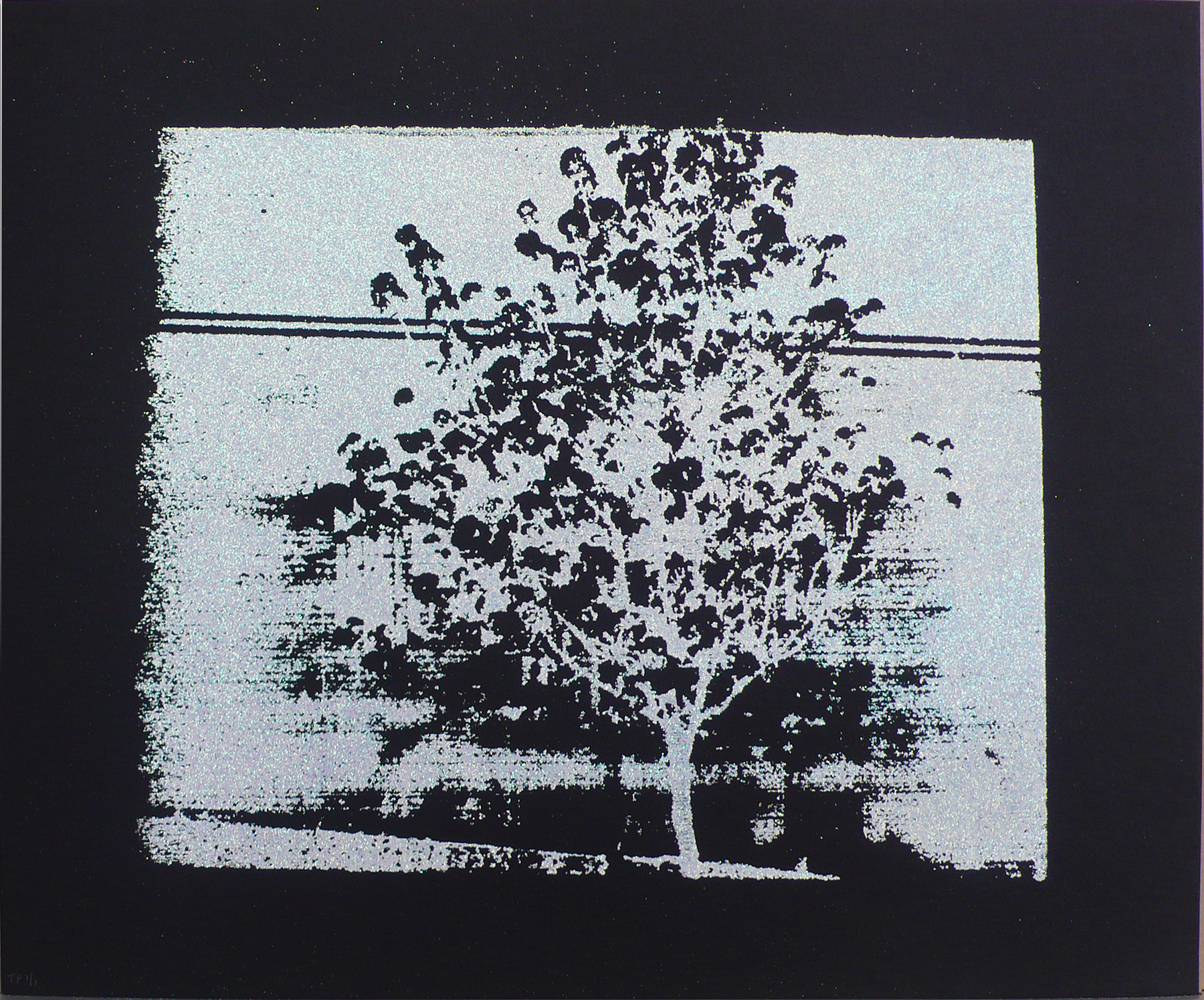
Sheridan’s second public image is “Tree”, a centralized spray of glittered branches, appropriate as an iconic affirmation of new life. When he moved his studio to a rundown industrial area of Jersey City, the cityscape was fairly bleak. But the new mayor had people planting trees. “They were just sticks in the ground, which turned into these trees the next spring” says the artist, in amazement. Processing a polaroid through the fax machine to get a grainy image of new life struggling to express itself, the Trees sparkle and twinkle their lightness of being.
In 2004, he began making large Elvis paintings, distinguished from Andy’s by the use of pearlescent “interference” color which changes from champagne to pink as one moves. Sheridan believes Elvis is the strongest and most beautiful of the Warhol images. He sees these works as clear homage to Andy, as extensions of Andy’s work, as paintings which were never done. A number of large Elvises have been placed in collections in both American and Europe.
The image of Jackie, also, has been produced by Sheridan, but larger and in yellow rather than blue. His newest series is “Flowers for Andy”, 42” square rather than Andy’s 40”, being produced for Fred Dorfman’s GARDEN show this summer in Bridgehampton. Curiously, some years ago, Sheridan made Flowers as ten foot square canvases for Sturtevant, the great appropriation artist who challenged the supremacy of originality in art. As Sheridan sees it, there is something quite joyful about making more Warhols available to the world, about extending Warhol’s oeuvre, about creating more Warhols for delectation. Andy would be pleased.
Brimming with ideas for new works, including contemporary Disasters, and variations on the Dollar Sign —all in honor of Andy— Sheridan says “I learned everything I know from him… if it weren’t for Andy, I’d be a psychiatrist. Making art is a different kind of psychiatry I guess.”